Rethinking Food Systems: Insights from the FSE Capstone Trip
An opinion piece by Elke Schrenk, Spring 2026
Students in the Food, Environment, and Sustainability (FSE) program concluded the semester with a capstone trip to the Emilia Romagna region. Students visited a number of producers to learn about how regional food products are made, connecting this to FSE classes. Here, I will provide a recap of the experience along with some key takeaways.
Alternative Food Production Models
The first stop on the trip was Il Grifo, a small scale pig farm near Reggio Emilia. What is unique about this farm is the fact that they complete all parts of the salami production process on the same property, from raising the pigs to curing the meat. Instead of being kept in large facilities and fed corn or other processed animal feed, the pigs at Il Grifo eat hay that is grown onsite. The farm aims to operate in an alternative way to intensive, large scale facilities by keeping production hyper local, and adhering to circular economy principles. Instead of focusing on producing a high quantity of meat for a low price, the farmers here are committed to creating comfortable and happy living conditions for their pigs. The farm serves as both a model for what livestock production looked like 70 years ago, and also what it could look like in a more sustainable future.
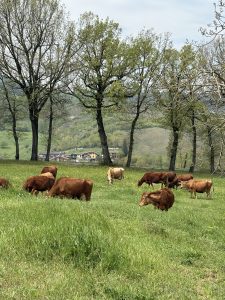 After a long lunch at Il Grifo we visited another farm, Azienda Agricola Capieste. This is a medium scale cow farm producing milk for parmigiano reggiano cheese. The cows here are Holsteins, which is a Dutch breed of cow introduced to Italy in the 1950s. While these cows are great at producing large quantities of milk, they are not the same as the Romagnola and Rossa Reggiana cow breeds that were historically used for parmigiano reggiano production.
After spending the night in Modena, we started day 2 with a visit to a Parmigiano reggiano factory, 4 Madonne. The company is actually a cooperation of farmers in the region, owning 8 factories in total. We were able to see the process of making a wheel of parmigiano from start to finish, and even got to taste some cheese. While the main elements of this cheese production have largely remained the same, there are some huge differences in how the cheese is made today. Because the factory produces such a large quantity of cheese, parts of the process which were done by hand in the past are now produced using machines. After learning about the production of cheese itself, we talked about the requirements for parmigiano to have that name. Learning about DOP and IGP certifications was something I found interesting about the capstone trip as a whole. This level of regionality and cultural significance in relation to food is not something that exists in the United States, and it was really unique to hear about the efforts made to preserve regional food culture. 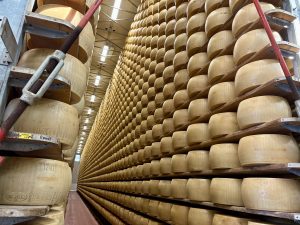
After the visit to 4 Maddone, we paid a visit to Daniele Cazzolla’s red cows farm. While this farm also produces milk for making parmigiano cheese, it provided a contrast to Azienda Agricola Capieste because of its extremely small scale. The red cow farm only raises traditional breeds from the region, not the Holsteins we saw at Azienda Agricola Capieste. It was clear from this visit that the cows were extremely well cared for, and that their wellbeing was at the forefront of the farm’s operations. Although the farms that we visited differed in size, they were both extremely small compared to the cow farms in the United States. For me, the visits to these two cow farms as well as the trip to Il Grifo served as a reminder for how important it is to buy ethically produced animal products. While it may cost less to buy mass produced animal products, there is a non-monetary, environmental cost that everyone in the world pays for.
Care and Culture in Food Production
Our next two visits provided another comparison between large and small scale food production. First we visited Acetum, the top producer of Balsamic Vinegar of Modena PGI. Here, we learned about the history, methods, and sustainability related to balsamic vinegar production. Acetum produces both PGI and DOP protected Balsamic vinegar, which are both made using traditional methods but have different requirements surrounding aging. Another interesting aspect of this visit was the fact that Acetum is a B-corporation, meaning they adhere to a number of social and environmentally responsible practices. It was interesting to see what this certification looks like in practice, as we have discussed B-corp certification in my past environmental science classes.
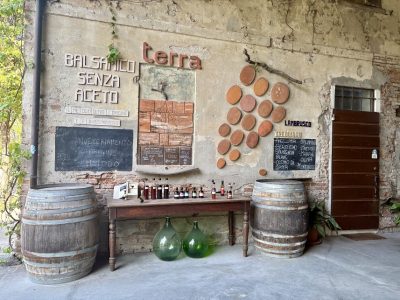
Our second to last visit to Acetaia San Giacomo provided a huge contrast to this. This small-scale balsamic vinegar production is run by only 6 employees, producing DOP balsamic vinegar with historical methods. It was extremely insightful to compare this type of production with what we saw at Acetum.
Takeaways
Overall, I thought this trip was the perfect culmination of everything we have learned in the Food and Environment Program. There is a huge difference between learning about food production in class and actually seeing how it is done in real life. This trip provided insight into how sustainability actually looks in food production through unique visits that would have been difficult to access if not for Umbra staff.
Personally, this visit shifted the way I view both sustainability and tradition when it comes to food. It is easy to think that just because something is “traditional,” it must also be sustainable. This visit raised questions about what both of those words really mean. I am left wondering at what point a business becomes less about preserving culinary culture and more about profits.