Studying Abroad, Without Leaving
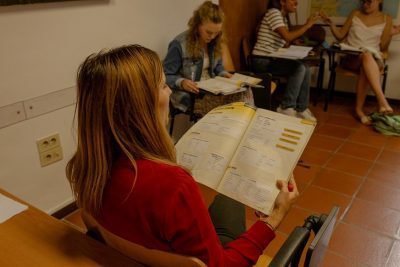
An opinion piece by Bianca Gnoli, University of Perugia student at the Umbra Institute, Fall 2025
If you’re wondering why there are Italian students studying at the Umbra Institute, this blog is for you. The differences between the Italian and American education systems are fascinating—distinct, yet not incompatible. Here’s my experience studying at the Umbra Institute.
Growing Up in the Italian System
As an Italian student, I grew up within the Italian school system—known for its long lectures, professors who speak for hours (sometimes so fast that it’s a challenge to take notes), and oral exams that are common and can determine 100% of your final grade. When I found myself studying side by side with American students at the Umbra Institute, I quickly realized how different our approaches to learning truly are.
Different Paths
The first difference lies in how we approach our academic journeys. In Italy, education is built around early specialization. Teenagers choose a field of study in high school, and that decision shapes their entire academic future. For example, I attended an art school, where everything I studied revolved around art history, painting, architecture, and sculpture. Professors encouraged us to continue into Fine Arts Academies or university art programs.
At Umbra, when I met my classmates from the U.S. school system, I was surprised by their academic flexibility. In the U.S., students can explore multiple disciplines before declaring a major—something unheard of in the Italian model. A biology student might take a literature or philosophy course just out of curiosity—and that’s considered completely normal.
At first, this seemed chaotic to me. I was used to a straight academic line: choose your subject, follow it, master it. But the more I spoke with my American peers, the more I appreciated their flexibility. Their system teaches graduates to think across disciplines, adapt easily, and embrace curiosity—qualities that are becoming essential in today’s world.
Inside the Classroom  Another striking difference lies in what happens during class. In Italian universities, classes are usually lecture-based. Professors talk, students listen, take notes, and study independently afterward. Questions are often reserved for the end.
In contrast, American-style classrooms encourage active participation. Students debate ideas, ask questions, and collaborate on group projects. They learn by engaging directly with both the material and their classmates.
At first, this felt intimidating. I was hesitant to speak up for fear of being wrong or sounding unprepared. But day by day, I learned from my peers to express my opinions without the expectation of being perfect, and I became more confident and straightforward.
Exams and Expectations
In Italy, grades often depend on a single final exam, frequently oral. Students sit across from the professor and must demonstrate their understanding—and their ability to think and speak clearly—on the spot. It’s intense, and honestly, quite terrifying at times.
By contrast, the American model emphasizes continuous assessment through smaller assignments, quizzes, and projects. For Italians, this can feel unusual at first, but many of us end up appreciating it. Spreading evaluation over time reduces pressure and encourages steady learning.
Relationships with Professors
Another cultural difference lies in how students and professors interact. In Italy, students use formal titles and usually contact them only during office hours. The relationship is professional and largely academic.
At Umbra, I found a different approach. Professors are approachable and often act as mentors. They encourage dialogue, invite questions, and take time to discuss students’ goals and progress. This kind of relationship fosters confidence and personal growth—it transforms the classroom into a community.
Learning Beyond the Lecture
The real exchange between Italian and American students at Umbra goes far beyond academics. Learning happens in daily moments—coffee breaks, shared meals, and casual conversations. Through these, we all grow.
What I Take Away
My experience at Umbra taught me that education isn’t about choosing one approach over another. It’s about combining the best of both: structure with flexibility.
Each project, discussion, and class break became a small lesson in how learning connects people from different worlds. In a time when global understanding matters more than ever, this kind of exchange reminds us that studying abroad doesn’t always mean leaving home—it can also mean discovering new worlds within your own city.