Truffle Culture in Umbria
An opinion piece by Elke Schrenk, Spring 2026
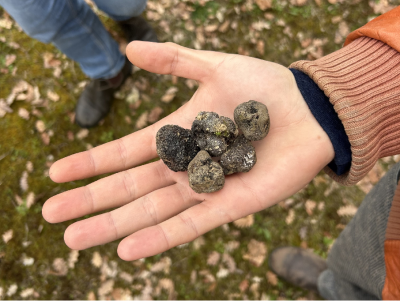
A recap of the Food, Sustainability, and Environment program for a trip to Scuola del Tartufo, where students learned about the process, history, and policy surrounding truffle cultivation. Truffles are a highly prized type of mushroom, which the Umbria region is famous for.
Learning from an Expert
Our experience started with a short lecture from Matteo Bartolini, truffle hunter and economist. He introduced us to the history and basic principles of truffle hunting, and discussed some of the contemporary issues in the field. It is clear that this practice is extremely important in Italian, and specifically Umbrian culture. 90% of the world’s truffles are produced in Italy, and of that number 98% are produced in Umbria.
Tradition, Family, and Changing Dynamics
Bartolini explained how his father taught him how to hunt for truffles, and how he is now passing down the same knowledge to his son. While truffle hunting has served as an important source of community connection in the past, the culture has now shifted to become quite competitive. Economic and political motivations have caused tense relations between competing farms, creating a new set of challenges for farmers.
Understanding Truffle Cultivation
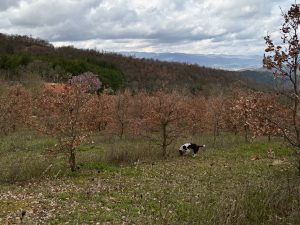
We then moved to the field, joined by Bartolini’s dog, Luna, and his father. The farm itself was different from any other type of agriculture that I have seen. Bartolini’s land consists of many different plots of oak trees, with truffles growing on the roots. When deciding to start a farm, soil tests must be conducted to test if the land is suitable for truffle production. If it is, oak trees are planted and truffle growth is encouraged by pouring water with spores onto the roots of the trees. After some time, truffles will grow.
When we walked out to the field, Luna was eager to start hunting. Bartolini had explained to us how the success of a hunt does not only depend on the dog’s natural ability to smell, but also on their training and eagerness to participate. After just a short time watching Luna, it was clear that she was a natural. She ran from tree to tree smelling for truffles, retrieving them from the ground and dutifully bringing them to Bartolini’s father in her mouth. In just a short time, Luna had found a handful of large truffles.
Tradition Meets Sustainability
What struck me the most about the trip to Bartolini’s property was the
connection between business, nature, and culture that is present in the process of truffle hunting. This type of cultivation is impossible to mass produce because of the equally necessary contributions needed from the land, animals, and people. While truffles are a highly lucrative business, they also represent cultural and historical ties between Umbrian land and people. I think that it is often easy for conversations about business and sustainability to become very technical, considering only how to maximize profits while minimizing environmental harm. Bartolini’s model for truffle cultivation demonstrates the importance of maintaining the human, cultural element within business, considering this alongside financial and sustainability goals.